Kvarner is an inexhaustible wealth of wines made from indigenous grape varieties.
At the end of the 19th century, there were a large number of indigenous grape varieties, and authors of the time listed and described over a hundred indigenous varieties. Today, Kvarner winemakers produce wines mostly from indigenous cultivars, with the Žlahtina variety playing a dominant role. In addition to Žlahtina, Kvarner winemakers also produce other wines from indigenous varieties such as Sansigot or Sušćan, Trojišćina, Jarbola, and indigenous grape varieties that are a component of the Kastavska Belica blend (Mejsko Belo, Divjaka, Brajkovac). These indigenous cultivars are grown exclusively in the Kvarner region and by definition belong to the grape varieties that have been grown in this area “since ancient times” and are not found anywhere else in cultivation. Although they are sometimes less economically profitable to grow, which is perhaps the biggest reason for their endangerment and reduction in area, indigenous (traditional, original) varieties have taken a dominant place in cultivation and production in Kvarner due to their varietal characteristics and qualitative potential.
In the wine-growing region of Croatia, Istria and Kvarner, in the sub-region of Kvarner and the Croatian Littoral, only 188 ha of vineyards were registered in 2023. On such a small vineyard area and small vineyards, production is negligible by world standards. In recent years, new trends have emerged in viticulture and the world wine market. The hyperproduction of mass wines has become a problem in many countries, and cheap wines are finding it increasingly difficult to find their way to the buyer. Modern consumers increasingly value quality, originality (authenticity, authenticity) and ecologically produced wines, which leads to different views on the development of viticulture and winemaking. Today, on the global and EU markets, and especially by tourist guests and domestic consumers, there is an increasing demand for typical and indigenous products such as wines from indigenous grape varieties, which also achieve very high prices. Indigenous wines of Kvarner are an absolute positive example and a response to consumer tastes.
My choice is the Žlahtina from the Gospoja winery. Their wines combine knowledge, experience, love and tradition, but also dedication to the difficult and painstaking process of producing top-quality grapes and wine. The family produces all types of Žlahtina, starting from the extra brut sparkling wine Gospoja, the classic Žlahtina, through the semi-dry mass wine Gospoja to the dessert Žlahtina Sveta Nedija. I love their Žlahtina because they show all the splendor and potential in different styles and categories, which shows not only the possibilities of the variety but also the enological knowledge and dedication to wine. I would especially highlight their classic Žlahtina because it is a drinkable, light dry wine with moderate alcohol and a pleasant freshness that is especially pleasing in the summer months. What makes it even more special is its appeal and the pleasure of drinking and pairing it with different foods and on different occasions. In every sip, you will feel the "terroir" of the island and Kvarner. I can freely say that the Žlahtina from the Gospoja winery is an "all-around" wine or a wine for every occasion. An unmistakable choice!
And don't forget, dessert wine doesn't require a special occasion. It can be enjoyed at the end of any lunch or dinner, formal or casual, summer or winter.
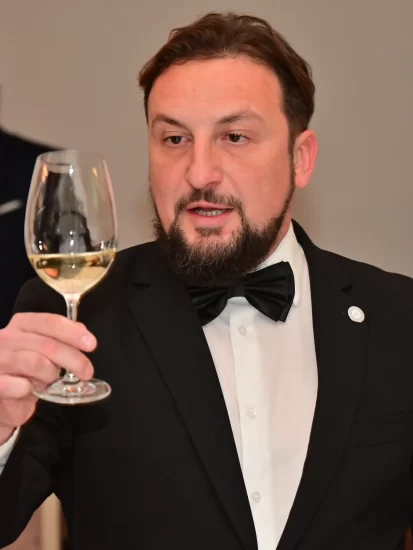
Tomislav Pavlešić – graduated from the Faculty of Agriculture, University of Zagreb, majoring in fruit growing-viticulture-winemaking, where he is also a doctoral candidate. For more than 20 years, he has managed some of the largest Croatian wineries as an enologist and head of laboratory and quality control. Since 2017, he has been an associate at the Faculty of Biotechnology and Drug Development, where he is the head of the University Enology Laboratory. He is an associate at the Chemistry of Food Aromas course, and also teaches at the Faculty of Medicine, the Faculty of Health Studies, and the Faculty of Economics, University of Rijeka. His field of work and research is enology with a special emphasis on aromas and food sensory (wine, sparkling wines, honey, strong alcohols, coffee, beer, oils), polyphenols, indigenous wine cultivars and honey, and wine culture. Particular emphasis in research is placed on analytics and quality control of production and finished products – wine, honey and olive oil (IR, NIR, FT-IR), as well as on the control of production processes in oenology and the food industry (grape harvest, grape processing, wine production – fermentation, clarification, stabilization, filtration, blending, tasting, laboratory processes). He is a member of the Croatian Oenological Society, the Croatian Association of Honey Sensory Analysts, the Croatian Agronomic Society and the European Order of Wine Knights, Consulate Croatia. He is a licensed sensory evaluator for wines and honey.