Žlahtina is the most important local, indigenous white wine, indispensable for experiencing Kvarner as an eno-gastro destination. Its appearance, aroma and taste are captivating!
In Kvarner, a region of fine winemakers, as many as 851 TP3T of the vines are native varieties. Besides Žlahtina, be sure to try Sansigota, Trojišćina, Jarbol, Belica… Cheers!
Žlahtina, or Žlajtina, is an indigenous Croatian and Kvarner white grape variety. It takes its name from the Slavic adjective „žlahten”, meaning “noble”. Because of its name, it was often associated with „plemenke“ (Old Russian: žlahtan – meaning of a cultivated, good variety; noble), but genetic analysis has shown it to be a unique, i.e., indigenous variety. Other synonyms include Žlajtina or Belina. The origin of Žlahtina has not been established, but it is considered an indigenous variety of the Kvarner islands and the coastal region. It has a narrow distribution area and is found almost exclusively in the Croatian coast and the Kvarner islands. In Croatia, it is grown on approximately 152 hectares, of which almost 95 hectares are in Primorje-Gorski Kotar County. The largest areas of cultivation are on the Vrbnik Plain on the island of Krk, but there are also large areas in the Novi Vinodolski Plain and the hinterland of Selce. It can be found in small quantities in Istria, while it is not present in other parts of Croatia. When we know that the total official area of vineyards in Primorsko-Goranska County as of 31 December 2022. hectares, according to data from the Ministry of Agriculture, then it is clear how important and significant this variety is for the viticultural and winemaking production in our region.
Practical experience and economic importance
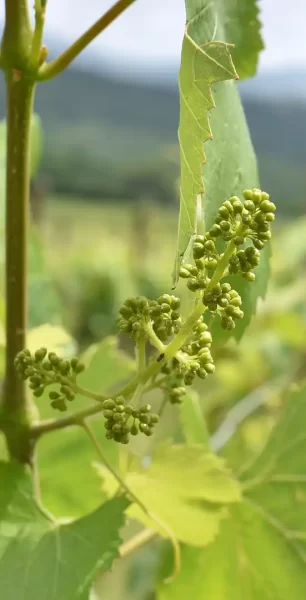
The clusters are large with evenly developed berries. Given its high bearing potential, it yields abundantly on fertile soils, which is directly reflected in the quality of the wine. On elevated, sunny sites, it yields top quality. Žlahtina produces fresh wines of medium body and strength, which is sometimes achieved even with higher yields. For the production of „heavier“, fuller-bodied and higher-alcohol wines, it is necessary to select warm, sunny sites and less fertile soils.
Žlahtina wines are best known as young wines, while Žlahtinas from particular vintages in exceptionally good sites are suitable for longer ageing. The variety is characterised by higher acidity than most other varieties grown in this region, a lovely freshness and balance, which classifies it among quality and premium varieties. It is precisely this freshness that leads to Žlahtina being used in the production of sparkling wines, where the winemakers of Kvarner are among the best in Croatia for both quantity and particularly high quality.
Due to the great publicity that Žlahtina wines have earned in the last twenty years, the population is growing and the areas under cultivation for Žlahtina are increasing, both on the island of Krk and in the coastal region where Žlahtina is the most widespread and economically most significant variety. Although Žlahtina is a relatively small-scale variety in terms of production, compared with Graševina, Plavac Mali and Malvazija, it is quite popular in domestic circles. The collaboration of all stakeholders in branding the Primorje-Gorski Kotar County as the „Region of Indigenous Wines“ has certainly been most instrumental in promoting Žlahtina (almost 85% of the grapevine varieties in our region belong to the group of indigenous varieties), starting with the winemakers themselves, the „Kvarner Wines“ association, the Kvarner Tourist Board, the academic and scientific community, and the local authorities.
Tomislav Pavlešić
University of Rijeka
Wine professionals sampled around forty Žlahtina wines of various styles and described the most important local, indigenous white wine, indispensable for experiencing Kvarner as an eno-gastro destination. Its appearance, aroma and flavour are captivating!
The recommended serving temperature of 8 °C beautifully reveals all the charms of this noble wine: the wine is crystal clear, pale straw-yellow in colour with a greenish hue.
On the nose it is clean, dominated by fruity-floral aromas of green apple, vineyard peach and a cocktail of citrus and tropical fruit. Notes of white flowers intertwine with the characteristic herbal aromas of Mediterranean herbs, particularly sage.
On the palate it is dry, with pronounced freshness and a lighter body. In the aftertaste it is fruity-herbal in character, with a distinct elegant saline sensation and a finish marked by a pleasant bitterness.
The recommended glass for Žlahtina is a smaller-capacity, narrower-bodied wine glass, to preserve the wine's fruitiness, freshness and optimal temperature.
Dare to sample other local, indigenous wines. No fewer than 85 per cent of the vines grown in Kvarner belong to indigenous varieties. This fact speaks to the superb terroir, the love, immense effort and perseverance of the grape-growers and winemakers, and to the identity of Kvarner. We should be proud of it!
The method of cultivation and production, as well as ageing, also determine the desirable food pairings, with fine wines and local produce being an ideal match:
Sparkling and young, fresh Žlahtina wines are an excellent accompaniment to the cold and hot starters of Kvarner cuisine, with an emphasis on fish, shellfish, and molluscs, especially raw Kvarner prawns, young island and Grobić cheeses, Krk ham, and buzara and pasta dishes such as šurlice, based on lighter sauces with porcini mushrooms or wild asparagus. Aged, more structured Žlahtina is an excellent partner for Creset lamb, brudet, gregada, fish in the oven – whether grilled or from the spit – as well as octopus cooked under a lid. It also pairs beautifully with roasted Lovran chestnuts.
Dessert wines are an excellent choice with Kvarner sweets such as kroštule, Vrbnik presnac, smokvenjak, the Rapska and Frankopanska torte, grašnjak, orehnjača, Rijeka rigojanči and strudel with Lovran cherries or Gorski borovnice and other wild berries.
Text: Tourist Board of Kvarner
Visit Kvarner, Drink Local, Tea Local, Kvarner Wine